In my last post I explored the Monty Hall problem, and specifically the differences between the standard version in which Monty has knowledge, and what I called the Opponent version in which a door is revealed randomly.
In this post I won't go into that detail, I'm going to assume that you're now familiar with both versions and you know that the Monty version wins 2/3 of the time if you switch, while the Opponent version is still 50/50, even if you don't understand why. In the comments of that original post I described an alternate way to view the problem that, for me at least, makes this whole thing really obvious. I haven't seen it described that way elsewhere, so I want to elaborate in the hopes that this will help some people intuitively see why Monty Hall works, as well as why that isn't initially obvious.
I want to show you the smoke and mirrors at work.
I'm going to describe a number of scenarios. It will not be obvious at first, but every one of these scenarios will be equivalent to the standard Monty Hall problem. I will begin with a version in which it is (probably) super-obvious to you that switching is the right thing to do, and then move gently towards the standard Monty Hall description where things are less obvious but still identical when you look behind the curtain. In all versions, the problem is the same as the standard Monty Hall except in the ways described.
It is my hope that you will see that these problems are all the same, and that they only differ in how well they hide the advantage you receive by switching.
Version 1. The super-obvious version:
You pick Door 1, but it is not opened.
Monty gives you the option to instead choose to open both Doors 2 and 3, and if the prize is behind either one of them, you win.
Should you switch?
This one is obvious, or should be. You get to win if the prize is behind either Door 2 or Door 3, giving you a 2/3 chance to win if you switch. Critical concepts that will be repeated in all other versions are:
- This is a 2-for-1 guess, that is why you get a 2/3 chance to win if you switch.
- Another way to look at that is that you've been given the opportunity to make 1 choice that actually reveals a pair of doors.
All future versions will contain these same features; that is why they work.
Version 2:
You pick Door 1, but it is not opened.
Monty tells you that, if the prize is behind Door 2, he is going to move it to Door 3. If the prize is behind Door 3, he is going to leave it there.
You are then given the chance to open Door 3 instead of Door 1.
Should you switch?
Yes, absolutely. Door 3 now wins if it had the prize originally, or if the prize was originally behind Door 2. Only if the prize was originally behind Door 1 does switching lose. You have a 2/3 chance, and again we have been given a single choice that essentially reveals a pair of doors.
Version 3:
You pick Door 1, but it is not opened.
Monty tells you that you can pick Doors 2 and 3 as a pair, and if the prize is behind either one of them, he will open that door, and you will win.
Should you switch?
Yes. If the prize is behind either door you win, giving you a 2/3 chance by switching. Again the doors are treated as a pair.
Version 4:
You pick Door 1, but it is not opened.
Monty tells you that you can pick Doors 2 and 3 as a pair. If you do so and the prize is behind one of them, he will open the other one (the loser) and then let you actually open the winner.
Should you switch?
Yes. If the prize is behind either door you win, giving you a 2/3 chance by switching. Again the doors are treated as a pair. Notice how close we are to the description of the original problem.
Version 5:
You pick Door 1, but it is not opened.
Monty tells you that he is going to open a losing door from the pair of doors made by Doors 2 and 3. He will then give you the option to switch to the unopened door.
Should you switch?
Yes. Same as before, these doors are treated as a pair. 2/3 chance to win by switching. Notice how this is identical to the previous version.
Version 6, the original problem re-framed to not specify which door Monty opened:
You pick Door 1, but it is not opened.
Monty tells you that he is going open a losing door, but he will never open the door you've already picked. He will then give you the option to switch to the remaining door.
Should you switch?
Yes. 2/3 chance to win by switching. Though he hasn't said so explicitly, Monty is treating Doors 2 and 3 as a pair because he isn't going to open the door you already picked. His choice therefore is out of Doors 2 & 3, and by using his knowledge to eliminate a sure loser from that pair, he makes it so that you have 1 choice that wins if either of these doors has the prize. It is more obvious that they are a pair here, than in the standard Monty version, because we have not specified which of the two is a loser, and which remains.
Version 7, the original problem:
You pick Door 1, but it is not opened.
Monty tells you that he is going to open a losing door for you.
Monty opens Door 3, revealing a goat.
You are given the option to switch to Door 2.
Should you switch?
Yes. You have a 2/3 chance to win by switching. What makes this trick your mind is that you are likely to frame the problem as "Should I pick Door 1 or Door 2?" when the correct framing is "Should I pick Door 1 or the door that remains from the Door 2/Door 3 pair?" (which in this particular case happens to be Door 2) As in all other versions, Doors 2 & 3 are treated as a pair. You get to win if the prize was behind either of them. You get a 2-for-1 guess, but if you're thinking of Door 2 as itself and not as representative of the pair, then your brain is likely to experience the disbelief that makes this a veridical paradox. Your choice is not between two doors, but between a single door and a pair of doors. When given the opportunity to switch to a pair of doors, your brain gets it. When given the opportunity to switch to a door that represents a pair of doors, your brain can easily miss the hidden value there.
The Monty version (knowledge based choice) isn't the same as the Opponent version (random choice) because in the Opponent version the opponent is opening a door that might be a winner. If the prize is revealed, you lose. Monty never reveals the prize, he reveals information that gives you the option to make a 2-for-1 guess. In this way, Monty's action is guaranteed to help you, whereas the opponent will cause you to immediately lose 1/3 of the time (the times when he guesses correctly.) Nothing that the opponent does creates a situation where you can win if either of 2 doors has the prize. The opponent does not create a 2-for-1 guess for you.
Does this help make the problem intuitive for anyone else?
Saturday, May 5, 2012

Thursday, May 3, 2012
Knowledge and Monty Hall
Sam Harris' book, The Moral Landscape, introduced me to the Monty Hall problem. People who love big words call this problem a veridical paradox, which basically means that the correct answer defies common sense. Most people, even after having the answer explained to them, still have this unsettled feeling about it. If you've never seen this before, you are almost guaranteed to think "but that can't be right!"
You can read about the problem on the Wikipedia page I linked above. You can also read a description by Barbara Drescher here. The purpose in bringing this up is to illustrate how our brains can fail us. How common sense can be dead wrong. How an assumption about the world can therefore be dead wrong, and how critical it is that we look deeply and think critically.
This applies to all sorts of things. Evolution, for example, is not an intuitively obvious process, and I suspect that this is the source of much resistance to the idea. Even after understanding evolution I sometimes think about the complexity of even a goldfish and think "wait, that isn't designed?"
So back to Monty Hall. Here's the most popular version of it:
Suppose you're on a game show, and you're given the choice of three doors: Behind one door is a car; behind the others, goats. You pick a door, say No. 1 [but the door is not opened], and the host, who knows what's behind the doors, opens another door, say No. 3, which has a goat. He then says to you, "Do you want to pick door No. 2?" Is it to your advantage to switch your choice?
The answer is yes, it is to your advantage to switch, because if the odds of Door No. 1 winning are 1 in 3, and the odds of Door No.3 winning are 2 in 3. Your brain might riot at this suggestion, but its true. I will briefly describe why this works a little later, but the links to Wikipedia and Drescher above include pretty pictures, so you may prefer that. The odds are not equal between these two doors. The key thing that your brain probably does not intuitively recognize is that you have the ability to take advantage of someone else's knowledge.
Drescher's description of the problem and its solution included this phrase:
"The issue of knowledge is a factor in our processing of the problem, but it’s not what Monty knows that matters. It’s what you (the subject of the problem) know."
It is not clear to me whether Drescher has misunderstood the deeper nature of the problem, or if she has just been unclear with her wording. In any case, the phrase "it's not what Monty knows that matters" is very misleading. What Monty knows is crucial. What Monty knows is what makes this whole thing work. What Monty knows about which door is the winner is what makes these two options unequal.
To illustrate this, we can change the problem slightly. This time, instead of Monty opening the other door, we will alter the problem so that you have an opponent:
Suppose you're on a game show, in the final round with your opponent. Because you are ahead, you are allowed to reserve a door (but not open it) before your opponent picks. Behind one door is a car; behind the others, goats. You pick Door No. 1 but the door is not opened. Your opponent picks Door No. 3 and this door is opened, revealing a goat. Your host now gives you the opportunity to switch to Door No. 2 if you wish. Is it to your advantage to switch?
In this case, the answer is no, it does not matter. Door No.1 and Door No.2 in this version of the problem have equal chances to be correct, and the difference is that your opponent did not have any knowledge of which door was the winner when she picked Door No. 3. It was not a revealing of information, it was a guess. You do get more information, in the sense that you now know that Door No. 3 is a loser, but in this version that doesn't help you pick between 1 and 2. Here's why:
I find this easier to explain in the multiple universes sense. In the original problem, there are 3 possible universes that you could be living in:
Universe 1:
C G G <- the prizes behind the doors
1 2 3 <- the door numbers
^ ? ? <- the various guesses and reveals
In this universe there is a car (C) behind door number 1, and you have picked this door as shown by the (^) symbol. In this case Monty will reveal either door 2 or 3 and if you switch you will lose. This is the 1 case out of 3 where switching is not to your advantage.
Universe 2:
G C G
1 2 3
^ ? X
In this universe there is a car (C) behind door number 2. You have picked door 1 as shown by the (^) symbol. In this case Monty will always reveal door 3 (X), because Monty knows which door has the car. This is a case where you win if you switch your guess.
Universe 3:
G G C
1 2 3
^ X ?
In this universe the car is behind door 3, you have picked door 1, and Monty will always reveal door 2 (X) as a loser, because Monty knows. This is a case where you win if you switch your guess.
So that's the original problem, and in 2 of the 3 possible scenarios you win if you switch your guess.
Here's the altered version. In it, your opponent's guess is random, as was yours. For clarity we will pre-assume that you have guessed door no 1, and your opponent has guessed door no 2 in all cases. Since neither of you know anything about which doors is the winner, this configuration of guesses is essentially the same as any other.
Universe 1:
C G G
1 2 3
^ L ?
In this universe the car is behind 1, and your opponent has lost by guessing door 2 (L). If you switch you will lose.
Universe 2:
G C G
1 2 3
^ W ?
In this universe the car is behind 2, which your opponent has guessed (W). You lose. If you have a choice to make at all, you are not in this universe. Critically, this is the condition that never happens in the version where Monty reveals a door that he knows to be a loser for you, and this is what makes the two versions different. In the previous version this Universe is a winner for you, but in this one it is a loser.
Universe 3:
G G C
1 2 3
^ L ?
In this universe the car is behind 3, and you will win if you switch.
Out of these 3 universes, you can only be in 2 of them if you have a choice to make at all, and of those 2 possibilities, in one of them you win if you switch and in the other you lose if you switch. It's 50/50 this time.
So there's an extra layer of paradox. You picked 1, and someone opened another door, revealing a goat. Should you switch? It depends on what the person who opened the door knows. If Monty opened the door with the deliberate intent to reveal a loser to you, then you should switch because that makes your odds 2/3. If an opponent selected a door randomly and just happened to reveal that same losing door, then your chances are not affected by switching. One door is as good as the other.
This is so counter-intuitive that I built a computer simulation of the problem just to verify that I'm not crazy. The car placement is random. The contestant's guess is random. In the Monty version, Monty's reveal is not random, it is based on Monty's knowledge. In the Opponent version, the opponent's guess is random from the remaining choices.
Here's 1 million runs of the Monty version (Monty reveals, information added):
Opportunities for you to switch: 1,000,000
Wins: 667,103
As we claimed, you win 2/3 of the time in this version by switching, and you always have the chance to switch.
Here's 1 million runs of Opponent version (Opponent guesses, no information added):
Opponent guesses correctly: 333,246 times. (no chance for you to guess)
Opportunities for you to switch: 666,754 times.
Wins by switching: 333,417 times.
As you can see, in this version you win about 1/2 the time that you are given the opportunity to switch, or 1/3 of the time overall. In the Monty version all of those times when the Opponent guessed correctly would have instead been converted to a condition where you win if you switch.
We might as well call your opponent Scotty, because Scotty doesn't know. (NSFW, sexual humor, language. Also, Matt Damon!) Monty does know, and knowing is half the battle... or 2/3rds... or something.
Failures of human reasoning fascinate me.
You can read about the problem on the Wikipedia page I linked above. You can also read a description by Barbara Drescher here. The purpose in bringing this up is to illustrate how our brains can fail us. How common sense can be dead wrong. How an assumption about the world can therefore be dead wrong, and how critical it is that we look deeply and think critically.
This applies to all sorts of things. Evolution, for example, is not an intuitively obvious process, and I suspect that this is the source of much resistance to the idea. Even after understanding evolution I sometimes think about the complexity of even a goldfish and think "wait, that isn't designed?"
So back to Monty Hall. Here's the most popular version of it:
Suppose you're on a game show, and you're given the choice of three doors: Behind one door is a car; behind the others, goats. You pick a door, say No. 1 [but the door is not opened], and the host, who knows what's behind the doors, opens another door, say No. 3, which has a goat. He then says to you, "Do you want to pick door No. 2?" Is it to your advantage to switch your choice?
The answer is yes, it is to your advantage to switch, because if the odds of Door No. 1 winning are 1 in 3, and the odds of Door No.3 winning are 2 in 3. Your brain might riot at this suggestion, but its true. I will briefly describe why this works a little later, but the links to Wikipedia and Drescher above include pretty pictures, so you may prefer that. The odds are not equal between these two doors. The key thing that your brain probably does not intuitively recognize is that you have the ability to take advantage of someone else's knowledge.
Drescher's description of the problem and its solution included this phrase:
"The issue of knowledge is a factor in our processing of the problem, but it’s not what Monty knows that matters. It’s what you (the subject of the problem) know."
It is not clear to me whether Drescher has misunderstood the deeper nature of the problem, or if she has just been unclear with her wording. In any case, the phrase "it's not what Monty knows that matters" is very misleading. What Monty knows is crucial. What Monty knows is what makes this whole thing work. What Monty knows about which door is the winner is what makes these two options unequal.
To illustrate this, we can change the problem slightly. This time, instead of Monty opening the other door, we will alter the problem so that you have an opponent:
Suppose you're on a game show, in the final round with your opponent. Because you are ahead, you are allowed to reserve a door (but not open it) before your opponent picks. Behind one door is a car; behind the others, goats. You pick Door No. 1 but the door is not opened. Your opponent picks Door No. 3 and this door is opened, revealing a goat. Your host now gives you the opportunity to switch to Door No. 2 if you wish. Is it to your advantage to switch?
In this case, the answer is no, it does not matter. Door No.1 and Door No.2 in this version of the problem have equal chances to be correct, and the difference is that your opponent did not have any knowledge of which door was the winner when she picked Door No. 3. It was not a revealing of information, it was a guess. You do get more information, in the sense that you now know that Door No. 3 is a loser, but in this version that doesn't help you pick between 1 and 2. Here's why:
I find this easier to explain in the multiple universes sense. In the original problem, there are 3 possible universes that you could be living in:
Universe 1:
C G G <- the prizes behind the doors
1 2 3 <- the door numbers
^ ? ? <- the various guesses and reveals
In this universe there is a car (C) behind door number 1, and you have picked this door as shown by the (^) symbol. In this case Monty will reveal either door 2 or 3 and if you switch you will lose. This is the 1 case out of 3 where switching is not to your advantage.
Universe 2:
G C G
1 2 3
^ ? X
In this universe there is a car (C) behind door number 2. You have picked door 1 as shown by the (^) symbol. In this case Monty will always reveal door 3 (X), because Monty knows which door has the car. This is a case where you win if you switch your guess.
Universe 3:
G G C
1 2 3
^ X ?
In this universe the car is behind door 3, you have picked door 1, and Monty will always reveal door 2 (X) as a loser, because Monty knows. This is a case where you win if you switch your guess.
So that's the original problem, and in 2 of the 3 possible scenarios you win if you switch your guess.
Here's the altered version. In it, your opponent's guess is random, as was yours. For clarity we will pre-assume that you have guessed door no 1, and your opponent has guessed door no 2 in all cases. Since neither of you know anything about which doors is the winner, this configuration of guesses is essentially the same as any other.
Universe 1:
C G G
1 2 3
^ L ?
In this universe the car is behind 1, and your opponent has lost by guessing door 2 (L). If you switch you will lose.
Universe 2:
G C G
1 2 3
^ W ?
In this universe the car is behind 2, which your opponent has guessed (W). You lose. If you have a choice to make at all, you are not in this universe. Critically, this is the condition that never happens in the version where Monty reveals a door that he knows to be a loser for you, and this is what makes the two versions different. In the previous version this Universe is a winner for you, but in this one it is a loser.
Universe 3:
G G C
1 2 3
^ L ?
In this universe the car is behind 3, and you will win if you switch.
Out of these 3 universes, you can only be in 2 of them if you have a choice to make at all, and of those 2 possibilities, in one of them you win if you switch and in the other you lose if you switch. It's 50/50 this time.
So there's an extra layer of paradox. You picked 1, and someone opened another door, revealing a goat. Should you switch? It depends on what the person who opened the door knows. If Monty opened the door with the deliberate intent to reveal a loser to you, then you should switch because that makes your odds 2/3. If an opponent selected a door randomly and just happened to reveal that same losing door, then your chances are not affected by switching. One door is as good as the other.
This is so counter-intuitive that I built a computer simulation of the problem just to verify that I'm not crazy. The car placement is random. The contestant's guess is random. In the Monty version, Monty's reveal is not random, it is based on Monty's knowledge. In the Opponent version, the opponent's guess is random from the remaining choices.
Here's 1 million runs of the Monty version (Monty reveals, information added):
Opportunities for you to switch: 1,000,000
Wins: 667,103
As we claimed, you win 2/3 of the time in this version by switching, and you always have the chance to switch.
Here's 1 million runs of Opponent version (Opponent guesses, no information added):
Opponent guesses correctly: 333,246 times. (no chance for you to guess)
Opportunities for you to switch: 666,754 times.
Wins by switching: 333,417 times.
As you can see, in this version you win about 1/2 the time that you are given the opportunity to switch, or 1/3 of the time overall. In the Monty version all of those times when the Opponent guessed correctly would have instead been converted to a condition where you win if you switch.
We might as well call your opponent Scotty, because Scotty doesn't know. (NSFW, sexual humor, language. Also, Matt Damon!) Monty does know, and knowing is half the battle... or 2/3rds... or something.
Failures of human reasoning fascinate me.
Monday, April 30, 2012
Morality roundup
A few things worth sharing on the topic of morality:
First, and perhaps most importantly, Jonathan Haidt gives a TED talk on the differences in moral thinking between liberals and conservatives. I think liberals in particular will find this to be an interesting challenge to some of their preconceived notions. (19 min) Haidt also has a book on this topic, titled The Righteous Mind., which I have not read. Haidt is in the territory of moral relativism, cautioning us against the presumption that someone else's view must be wrong.
Next, in another TED talk, Frans de Waal explores moral behavior in other mammals: (17 min) He has written The Age of Empathy, which I have not read.
and Jessica Pierce describes some additional instances of animal morality that we have observed.
Finally, in this debate between Sam Harris and William Lane Craig, the origins of morality are explored. Harris is describing and defending the ideas that he has put forth in his new book, The Moral Landscape, which I am still reading. Harris' position is that morality stems from the well-being of conscious creatures, and that once we accept this assertion, morality can be objectively examined, even if it is neuroscience is not yet advanced enough to make this a practical matter in many cases. Harris' ideas challenge both the conservative notions of morality from God or other authority, as well as the liberal notions of moral relativism. Craig's position is the traditional theological notion that morality comes to us from divinity. Unfortunately Craig's opposition is largely focused on his refusal to accept that Harris has any basis to assume that well-being has any relationship with morality. While I recommend seeing the entire thing for fairness and context, in my opinion it is Harris and his ideas that makes this video worth the two hour investment.
(2hrs)
My personal take is that there is value in all of these. Haidt seems to describe morality as it is actually implemented by different people, and de Waal describes that natural origin of our moralistic impulses. I think the conservative ideas of morality sanctify principles that preserve the group in the face of extreme adversity. Probably these are behaviors that served us well in our more tribal past, but it does not seem to me that those ideas still serve us well now. I'm sure it will take you less than 10 seconds to think of several examples where authority and morality were at direct odds with each other. In-group thinking is valuable when groups compete, and destructive when they lose the opportunity to cooperate. Finally, purity would have been valuable in a time when medicine, sexual education, and contraceptive care were not available, but in modern times puritanical thinking seems to act to the detriment of women more than it accomplishes anything else.
Finally, while I embrace the idea of the equivalence of many different cultural values, I think Harris is right that there is an objectivity, or at least some objective elements, to morality. To say that it is abhorrent to stone rape victims to death, and to say that it is proper - these are not morally equivalent positions. We do not live in a world where all moral opinions are equal.
Overall, I am still exploring and refining my ideas on human morality, and have much more reading to do.
What do you think?
First, and perhaps most importantly, Jonathan Haidt gives a TED talk on the differences in moral thinking between liberals and conservatives. I think liberals in particular will find this to be an interesting challenge to some of their preconceived notions. (19 min) Haidt also has a book on this topic, titled The Righteous Mind., which I have not read. Haidt is in the territory of moral relativism, cautioning us against the presumption that someone else's view must be wrong.
Next, in another TED talk, Frans de Waal explores moral behavior in other mammals: (17 min) He has written The Age of Empathy, which I have not read.
and Jessica Pierce describes some additional instances of animal morality that we have observed.
Finally, in this debate between Sam Harris and William Lane Craig, the origins of morality are explored. Harris is describing and defending the ideas that he has put forth in his new book, The Moral Landscape, which I am still reading. Harris' position is that morality stems from the well-being of conscious creatures, and that once we accept this assertion, morality can be objectively examined, even if it is neuroscience is not yet advanced enough to make this a practical matter in many cases. Harris' ideas challenge both the conservative notions of morality from God or other authority, as well as the liberal notions of moral relativism. Craig's position is the traditional theological notion that morality comes to us from divinity. Unfortunately Craig's opposition is largely focused on his refusal to accept that Harris has any basis to assume that well-being has any relationship with morality. While I recommend seeing the entire thing for fairness and context, in my opinion it is Harris and his ideas that makes this video worth the two hour investment.
(2hrs)
My personal take is that there is value in all of these. Haidt seems to describe morality as it is actually implemented by different people, and de Waal describes that natural origin of our moralistic impulses. I think the conservative ideas of morality sanctify principles that preserve the group in the face of extreme adversity. Probably these are behaviors that served us well in our more tribal past, but it does not seem to me that those ideas still serve us well now. I'm sure it will take you less than 10 seconds to think of several examples where authority and morality were at direct odds with each other. In-group thinking is valuable when groups compete, and destructive when they lose the opportunity to cooperate. Finally, purity would have been valuable in a time when medicine, sexual education, and contraceptive care were not available, but in modern times puritanical thinking seems to act to the detriment of women more than it accomplishes anything else.
Finally, while I embrace the idea of the equivalence of many different cultural values, I think Harris is right that there is an objectivity, or at least some objective elements, to morality. To say that it is abhorrent to stone rape victims to death, and to say that it is proper - these are not morally equivalent positions. We do not live in a world where all moral opinions are equal.
Overall, I am still exploring and refining my ideas on human morality, and have much more reading to do.
What do you think?
Friday, April 27, 2012
God's will is a dangerous idea.
I want to address the claim that "goodness" comes from doing God's will. Some would even define goodness as being "an action that God wills", and that outside of knowing God's will, humanity cannot access goodness or morality.
These are very dangerous ideas. The people who hold them are often good people - moral, well-meaning people who probably reason that God, being infinitely good, would never will anything bad. From that perspective this idea makes sense, but let's look deeper:
1) God's will makes an action moral (and morally compulsory), no matter how awful we might otherwise think the action to be. This is not a hypothetical point. All of the Abrahamic religions (Judaism, Christianity, Islam) descend from Abraham. He was ordered by God to murder his child, and was going to do it, and in the Abrahamic faiths this is considered a righteous thing. In this story, Abraham was stopped from committing the deed, but the message of the tale is still clear: When God orders you to commit an atrocity, you do it. No questions asked.
2) In the minds of believers who subscribe to this, God willing an act either makes that act intrinsically moral or overrides all other moral considerations (depending on how exactly they view morality. For some there is no belief in "other moral considerations" to conflict with God's will in the first place because "do God's will" is the ultimate source of moral law.)
3) This can, and does, lead people to commit acts which they would otherwise condemn as immoral.
4) In cases where someone is thoroughly convinced that they are doing God's will, there is essentially nothing that can convince them that what they are doing is wrong. No argument can be made against this; God's will trumps all.
5) We find, even if you accept that God is real and has a will regarding human behavior, that people are extremely inconsistent in their understanding of what God's will is. God's will really only comes to people through 3 sources: divine text, spiritual leadership, and personal revelation. None of these provides any means of determining God's will which can be generally agreed upon by believers. Not only have the followers of Abraham split into 3 major religions, but within each of those religions there are myriad sects, each with their own particular interpretation.
For Christians, Christ brought a new message of love and fellowship to the religion, but also said "Do not think that I have come to abolish the Law or the Prophets; I have not come to abolish them but to fulfill them." These messages seem to conflict, and Christianity is rife with disagreement over what is or is not still the law in their post-Christ version of the Abrahamic faith.
On homosexuality, for example, Christianity varies widely. Some think that God's will is that homosexuals should be killed, and the Old Testament directly supports this. Others believe that homosexuality is a sin like any other, but that homosexuals themselves are still to be loved. Still others fully support and embrace homosexuals. A similar variety of opinion exists within Judaism, and indeed across world religions. Reasonable people of faith acknowledge that "sincere Christians can legitimately reach different conclusions on particular issues in good faith." So what then, is the will of God? It's a question that either no one can answer, or that everyone can answer and believe that they have the one true interpretation of God's will. As moral systems go, that is about as subjective as you can get.
6) According to the Old Testament, God has willed some things that almost any of us would find atrocious. This creates a situation where any command from God is plausible, because literally nothing would be out of line with what God has willed in the past. He did destroy the whole world after all, and has promised to do it again. If you accept that as a godly and good action, then nothing is off the table. Even the bringing of (nuclear?) Armageddon then becomes not a question of morality, but of timing. I do not suggest that most religious people would come to this conclusion, only that the conclusion is available to them and consistent with the doctrine of "God's will." (And surely, on a planet with 6 billion people, there are more than a handful that are truly this crazed.)
7) All of these together create a belief structure where it is possible for a person, in good faith, to believe that it is not only righteous to commit an atrocity, but morally required of them. History is rife with examples of this, and I will not repeat them all here. Suffice to say, if you looked into the heart of Al-Qaeda, or the Army of God, or the IRA, you will find people who sincerely believe that they are doing God's will. The same is no doubt true of Christian terrorists, Jewish terrorists, Muslim terrorists, and religious violence in general. God's will, God's will, God's will, and God's will.
That is the power and danger of this idea.
At the core of it all is the simple notion that normal human morality can be trumped, that there are circumstances in which it would be ok to murder your child. It is similar in this respect to the secular notion that "the ends justify the means." Both of these assert that good can be accomplished through acts that we would otherwise consider to be evil. Even though I believe that "the ends justify the means" is a very dangerous idea, I also acknowledge that it can at times be true. We can, in these circumstances, weigh the good that we expect, the evil to be done, and look to whether any net good is done. The real danger in that case is that the good result is often promised but seldom realized, whereas the evil done to achieve it is immediate and irrevocable. Almost all evil is performed in this fashion - villains do not wake in the morning, twist their mustaches, and set out to be as awful as possible. Even Hitler believed that what he was doing was morally justified, and so, we must be careful of our moral systems and how we allow ourselves to justify our actions. Any action justified with "the ends justify the means" should be considered thoroughly and with suspicion.
Not only does the doctrine of "God's will" allow us to trump normal human morality, but it does so in a fashion that is so vague, so subject to personal interpretation, that anyone can take any position whatsoever, claim it to be the will of God, and stubbornly believe that. Indeed, this is precisely what we see in the world and in history. The fact that most religious people will never go on a killing rampage for God does not excuse them for supporting a moral structure thatcan be is used to justify such actions.
"God's will" as an entire moral system is an idea that is morally bankrupt, both in theory and in practice. The key point here is not that religious people are immoral; that is obviously not true. The point is that this moral structure is wrong, and that those moral people who subscribe to the doctrine of "God's will" are moral despite this doctrine, and not because of it.
We simply must keep ourselves in check with a moral system that has objectively understandable benefits to ourselves and to others. Humanism is one such system. There are others, each concerned with the effects of our actions on ourselves and others. This is the foundation of morality, and this is why killing your child is not moral, even if you believe with all of your heart that God wills it. A moral belief structure that cannot make this distinction is a gateway to justifying evil, and history bears this out. A path of actual morality does not necessarily demand that you abandon your faith, or God, or your religion, but it does require that the doctrine of "God's will" be put aside.
These are very dangerous ideas. The people who hold them are often good people - moral, well-meaning people who probably reason that God, being infinitely good, would never will anything bad. From that perspective this idea makes sense, but let's look deeper:
1) God's will makes an action moral (and morally compulsory), no matter how awful we might otherwise think the action to be. This is not a hypothetical point. All of the Abrahamic religions (Judaism, Christianity, Islam) descend from Abraham. He was ordered by God to murder his child, and was going to do it, and in the Abrahamic faiths this is considered a righteous thing. In this story, Abraham was stopped from committing the deed, but the message of the tale is still clear: When God orders you to commit an atrocity, you do it. No questions asked.
2) In the minds of believers who subscribe to this, God willing an act either makes that act intrinsically moral or overrides all other moral considerations (depending on how exactly they view morality. For some there is no belief in "other moral considerations" to conflict with God's will in the first place because "do God's will" is the ultimate source of moral law.)
3) This can, and does, lead people to commit acts which they would otherwise condemn as immoral.
4) In cases where someone is thoroughly convinced that they are doing God's will, there is essentially nothing that can convince them that what they are doing is wrong. No argument can be made against this; God's will trumps all.
5) We find, even if you accept that God is real and has a will regarding human behavior, that people are extremely inconsistent in their understanding of what God's will is. God's will really only comes to people through 3 sources: divine text, spiritual leadership, and personal revelation. None of these provides any means of determining God's will which can be generally agreed upon by believers. Not only have the followers of Abraham split into 3 major religions, but within each of those religions there are myriad sects, each with their own particular interpretation.
For Christians, Christ brought a new message of love and fellowship to the religion, but also said "Do not think that I have come to abolish the Law or the Prophets; I have not come to abolish them but to fulfill them." These messages seem to conflict, and Christianity is rife with disagreement over what is or is not still the law in their post-Christ version of the Abrahamic faith.
On homosexuality, for example, Christianity varies widely. Some think that God's will is that homosexuals should be killed, and the Old Testament directly supports this. Others believe that homosexuality is a sin like any other, but that homosexuals themselves are still to be loved. Still others fully support and embrace homosexuals. A similar variety of opinion exists within Judaism, and indeed across world religions. Reasonable people of faith acknowledge that "sincere Christians can legitimately reach different conclusions on particular issues in good faith." So what then, is the will of God? It's a question that either no one can answer, or that everyone can answer and believe that they have the one true interpretation of God's will. As moral systems go, that is about as subjective as you can get.
6) According to the Old Testament, God has willed some things that almost any of us would find atrocious. This creates a situation where any command from God is plausible, because literally nothing would be out of line with what God has willed in the past. He did destroy the whole world after all, and has promised to do it again. If you accept that as a godly and good action, then nothing is off the table. Even the bringing of (nuclear?) Armageddon then becomes not a question of morality, but of timing. I do not suggest that most religious people would come to this conclusion, only that the conclusion is available to them and consistent with the doctrine of "God's will." (And surely, on a planet with 6 billion people, there are more than a handful that are truly this crazed.)
7) All of these together create a belief structure where it is possible for a person, in good faith, to believe that it is not only righteous to commit an atrocity, but morally required of them. History is rife with examples of this, and I will not repeat them all here. Suffice to say, if you looked into the heart of Al-Qaeda, or the Army of God, or the IRA, you will find people who sincerely believe that they are doing God's will. The same is no doubt true of Christian terrorists, Jewish terrorists, Muslim terrorists, and religious violence in general. God's will, God's will, God's will, and God's will.
That is the power and danger of this idea.
At the core of it all is the simple notion that normal human morality can be trumped, that there are circumstances in which it would be ok to murder your child. It is similar in this respect to the secular notion that "the ends justify the means." Both of these assert that good can be accomplished through acts that we would otherwise consider to be evil. Even though I believe that "the ends justify the means" is a very dangerous idea, I also acknowledge that it can at times be true. We can, in these circumstances, weigh the good that we expect, the evil to be done, and look to whether any net good is done. The real danger in that case is that the good result is often promised but seldom realized, whereas the evil done to achieve it is immediate and irrevocable. Almost all evil is performed in this fashion - villains do not wake in the morning, twist their mustaches, and set out to be as awful as possible. Even Hitler believed that what he was doing was morally justified, and so, we must be careful of our moral systems and how we allow ourselves to justify our actions. Any action justified with "the ends justify the means" should be considered thoroughly and with suspicion.
Not only does the doctrine of "God's will" allow us to trump normal human morality, but it does so in a fashion that is so vague, so subject to personal interpretation, that anyone can take any position whatsoever, claim it to be the will of God, and stubbornly believe that. Indeed, this is precisely what we see in the world and in history. The fact that most religious people will never go on a killing rampage for God does not excuse them for supporting a moral structure that
"God's will" as an entire moral system is an idea that is morally bankrupt, both in theory and in practice. The key point here is not that religious people are immoral; that is obviously not true. The point is that this moral structure is wrong, and that those moral people who subscribe to the doctrine of "God's will" are moral despite this doctrine, and not because of it.
We simply must keep ourselves in check with a moral system that has objectively understandable benefits to ourselves and to others. Humanism is one such system. There are others, each concerned with the effects of our actions on ourselves and others. This is the foundation of morality, and this is why killing your child is not moral, even if you believe with all of your heart that God wills it. A moral belief structure that cannot make this distinction is a gateway to justifying evil, and history bears this out. A path of actual morality does not necessarily demand that you abandon your faith, or God, or your religion, but it does require that the doctrine of "God's will" be put aside.
Wednesday, April 18, 2012
Evolution is wrong because birds.
A specific person, skeptical of evolution, asked for a plausible explanation to the question "How did flight evolve?"
There are layers of answers to this question, and others like it. I will start with the general and move toward the specific.
1) A missing piece of the story does not sink the theory.
Let me explain by way of analogy. A detective is investigating a murder. The victim was murdered in front of a dumpster in an alley with a single shot from a specific .357 magnum revolver. Despite public controversy surrounding the matter, the detective knows that this is the murder location because all evidence indicates that the victim was shot here:
- There is a .357 magnum sized bullet hole, corresponding damage, and the characteristic burns and other marks (I won't get graphic) associated with a gunshot wound of this caliber, in the victim's skull.
- A .357 magnum bullet, as well as blood and other biological material from the victim's skull, were found embedded in the front of the dumpster. Ballistics matches the bullet to a .357 magnum revolver which
- Was found in the dumpster, with signs of having been fired, as well as blood splatter from the victim.
- There is a huge amount of the victim's blood, almost all of it, in the dumpster.
- All blood at the scene matches the victim.
...and so on. It's airtight, the killing happened here.
However,
-The body was found on the roof of a nearby hotel.
-There is very little blood in the vicinity of the body, nor any other signs that someone was murdered here, apart from the body.
-The blood, which has settled and rigidified due to livermortis, is in the victim's back even though the victim is facedown.
-Going through the security tapes for the hotel, which are all date/time stamped and appear to cover all entrances and exits to the hotel, there does not appear to be anyone lugging a body up to the roof at any point.
-The body does not show additional damage that might be expected during careless transport.
Now, the detective has every reason to believe that the victim was murdered in the alley, in front of a dumpster, by a person with the .357 magnum they found in the dumpster, and that the body was thrown in the dumpster where it drained of blood and was later moved to the nearby roof. He has no idea how the body was later moved to the roof. He has no idea why. He can't explain how someone could have gotten the body up there without showing up on the security footage.
All of the ideas he can think of might seem implausible, such as:
- The body was moved by helicopter?
- The killer later wrapped the body in plastic and carefully hoisted up to the roof?
- The security tapes have been expertly tampered with?
- The body was cleverly hidden inside of luggage when it was moved?
None of these may seem satisfying to the detective, but it doesn't matter, he doesn't need to know the details of how the body got moved to the roof to know that this is what happened. The victim could not possibly have been killed on the roof, because the evidence does not match that scenario. The evidence is that this person was shot in front of the dumpster in the alley. There's a huge hole in his narrative, but it doesn't change the fact that the victim was murdered in the alley, and not on the roof. Nothing else explains the evidence; there are no other plausible options. Whatever questions he might have about who, or how, or why, the location of death is a fact.
People can say foolish things like "There's a body on the roof and you think he wasn't killed there? Like someone is really gonna carry a body to the roof. Derp derp. They even checked the security footage, and the body was miraculously not damaged during the "move". There's proof positive that no one moved this body." (I'll spare you the caps lock.)
These people might be convinced, and might convince others. They might start www.HeWasKilledOnTheRoof.com and generate a huge following, and have YouTube videos with 2.3 million views, and memes mocking the detective, but they still have no idea what they're talking about. They are amateur armchair detectives, they are flatly wrong, and the fact that no police or other serious investigators put stock in their version should indicate this to them, but they will prefer instead to assume some vast conspiracy to defile the truth in the name of some imagined agenda.
And so it is with Theory of Evolution. There are countless species on the Earth, and we do not need to know the details of how every feature of every species evolved to consider evolution an indisputable fact. Evolution is fact because there is no other explanation for the evidence. Even if scientists had no idea whatsoever how flying might have evolved, that would not disprove evolution, nor even cast any doubt upon it.
2) The "unbelievability" of a particular theory to a non-expert means nothing.
As do all of the arguments that sound convincing to non-experts, but have not swayed experts. I want to be clear that I am not invoking an Appeal to Authority Logical Fallacy here. It does not follow that evolution is necessarily true because expert scientists believe it.
However, a person who is not personally an expert in the subject is also not qualified to dismiss expert opinion on a matter. This is not to say that a non-expert couldn't uncover evidence or think of an argument that would overturn an established matter, but if experts have seen that evidence and heard that argument, and are unimpressed, and are still satisfied that the theory holds true, then there is no credible reason for a non-expert to believe otherwise.
It is the fool who prefers the word of the non-expert, or to rejects a matter simply because it is not personally understood. (This would be the Personal Incredulity Fallacy). It is, of course, not completely impossible that the non-expert is actually correct, but it's very unlikely, and if you go through life believing non-experts on all matters you're going to live an existence of ignorance. This is the realm of conspiracy theorists, snake oil purchasers, perpetual motion machine builders, seekers of Tesla's "free electricity", and so on. Don't fall for it. All those PhDs aren't stupid, or missing some obvious thing that you read on the internet.
3) The actual answer to your question
Is that the evolution of flight is an area under investigation, and there are several schools of thought. You can read some about it here in this article, or this one, or this one which I found by laboriously... no, wait. I just googled "what good is half a wing evolution". Answers about evolution are all over the internet. Seriously, try it sometime. You could also read this book, or, if you think you'd be able to read Dawkins without bursting into flames, this one.
4) Wash, Rinse, Repeat?
Most Creationists, after having one doubt addressed, will simply move to the next one. This is generally because the questions are not being asked in good faith, but in an attempt to find the "gotcha" problem that will stump the evolutionist and demonstrate how wrong they are. (Oh, the irony.)
Please don't do this. Seriously. I totally understand if evolution seems completely and utterly not-plausible to you. It's a pretty mind-blowing revelation, but look, so is Quantum, and Quantum is just true. I hate Quantum, it sounds like total nonsense, but apparently the universe doesn't care how I feel because Quantum is real. If you still have doubts about a scientific theory, see points 1 & 2. Google it, read some books, study the subject. If you aren't convinced by popular science write-ups and aren't satisfied with accepting expert opinion, then become a genuine expert yourself (Hint: this involves graduate work at a university). Only then will any clear-thinking person see your disbelief of an established scientific theory as anything other than an unfortunate misunderstanding on your part.
There are layers of answers to this question, and others like it. I will start with the general and move toward the specific.
1) A missing piece of the story does not sink the theory.
Let me explain by way of analogy. A detective is investigating a murder. The victim was murdered in front of a dumpster in an alley with a single shot from a specific .357 magnum revolver. Despite public controversy surrounding the matter, the detective knows that this is the murder location because all evidence indicates that the victim was shot here:
- There is a .357 magnum sized bullet hole, corresponding damage, and the characteristic burns and other marks (I won't get graphic) associated with a gunshot wound of this caliber, in the victim's skull.
- A .357 magnum bullet, as well as blood and other biological material from the victim's skull, were found embedded in the front of the dumpster. Ballistics matches the bullet to a .357 magnum revolver which
- Was found in the dumpster, with signs of having been fired, as well as blood splatter from the victim.
- There is a huge amount of the victim's blood, almost all of it, in the dumpster.
- All blood at the scene matches the victim.
...and so on. It's airtight, the killing happened here.
However,
-The body was found on the roof of a nearby hotel.
-There is very little blood in the vicinity of the body, nor any other signs that someone was murdered here, apart from the body.
-The blood, which has settled and rigidified due to livermortis, is in the victim's back even though the victim is facedown.
-Going through the security tapes for the hotel, which are all date/time stamped and appear to cover all entrances and exits to the hotel, there does not appear to be anyone lugging a body up to the roof at any point.
-The body does not show additional damage that might be expected during careless transport.
Now, the detective has every reason to believe that the victim was murdered in the alley, in front of a dumpster, by a person with the .357 magnum they found in the dumpster, and that the body was thrown in the dumpster where it drained of blood and was later moved to the nearby roof. He has no idea how the body was later moved to the roof. He has no idea why. He can't explain how someone could have gotten the body up there without showing up on the security footage.
All of the ideas he can think of might seem implausible, such as:
- The body was moved by helicopter?
- The killer later wrapped the body in plastic and carefully hoisted up to the roof?
- The security tapes have been expertly tampered with?
- The body was cleverly hidden inside of luggage when it was moved?
None of these may seem satisfying to the detective, but it doesn't matter, he doesn't need to know the details of how the body got moved to the roof to know that this is what happened. The victim could not possibly have been killed on the roof, because the evidence does not match that scenario. The evidence is that this person was shot in front of the dumpster in the alley. There's a huge hole in his narrative, but it doesn't change the fact that the victim was murdered in the alley, and not on the roof. Nothing else explains the evidence; there are no other plausible options. Whatever questions he might have about who, or how, or why, the location of death is a fact.
People can say foolish things like "There's a body on the roof and you think he wasn't killed there? Like someone is really gonna carry a body to the roof. Derp derp. They even checked the security footage, and the body was miraculously not damaged during the "move". There's proof positive that no one moved this body." (I'll spare you the caps lock.)
These people might be convinced, and might convince others. They might start www.HeWasKilledOnTheRoof.com and generate a huge following, and have YouTube videos with 2.3 million views, and memes mocking the detective, but they still have no idea what they're talking about. They are amateur armchair detectives, they are flatly wrong, and the fact that no police or other serious investigators put stock in their version should indicate this to them, but they will prefer instead to assume some vast conspiracy to defile the truth in the name of some imagined agenda.
And so it is with Theory of Evolution. There are countless species on the Earth, and we do not need to know the details of how every feature of every species evolved to consider evolution an indisputable fact. Evolution is fact because there is no other explanation for the evidence. Even if scientists had no idea whatsoever how flying might have evolved, that would not disprove evolution, nor even cast any doubt upon it.
2) The "unbelievability" of a particular theory to a non-expert means nothing.
As do all of the arguments that sound convincing to non-experts, but have not swayed experts. I want to be clear that I am not invoking an Appeal to Authority Logical Fallacy here. It does not follow that evolution is necessarily true because expert scientists believe it.
However, a person who is not personally an expert in the subject is also not qualified to dismiss expert opinion on a matter. This is not to say that a non-expert couldn't uncover evidence or think of an argument that would overturn an established matter, but if experts have seen that evidence and heard that argument, and are unimpressed, and are still satisfied that the theory holds true, then there is no credible reason for a non-expert to believe otherwise.
It is the fool who prefers the word of the non-expert, or to rejects a matter simply because it is not personally understood. (This would be the Personal Incredulity Fallacy). It is, of course, not completely impossible that the non-expert is actually correct, but it's very unlikely, and if you go through life believing non-experts on all matters you're going to live an existence of ignorance. This is the realm of conspiracy theorists, snake oil purchasers, perpetual motion machine builders, seekers of Tesla's "free electricity", and so on. Don't fall for it. All those PhDs aren't stupid, or missing some obvious thing that you read on the internet.
3) The actual answer to your question
Is that the evolution of flight is an area under investigation, and there are several schools of thought. You can read some about it here in this article, or this one, or this one which I found by laboriously... no, wait. I just googled "what good is half a wing evolution". Answers about evolution are all over the internet. Seriously, try it sometime. You could also read this book, or, if you think you'd be able to read Dawkins without bursting into flames, this one.
4) Wash, Rinse, Repeat?
Most Creationists, after having one doubt addressed, will simply move to the next one. This is generally because the questions are not being asked in good faith, but in an attempt to find the "gotcha" problem that will stump the evolutionist and demonstrate how wrong they are. (Oh, the irony.)
Please don't do this. Seriously. I totally understand if evolution seems completely and utterly not-plausible to you. It's a pretty mind-blowing revelation, but look, so is Quantum, and Quantum is just true. I hate Quantum, it sounds like total nonsense, but apparently the universe doesn't care how I feel because Quantum is real. If you still have doubts about a scientific theory, see points 1 & 2. Google it, read some books, study the subject. If you aren't convinced by popular science write-ups and aren't satisfied with accepting expert opinion, then become a genuine expert yourself (Hint: this involves graduate work at a university). Only then will any clear-thinking person see your disbelief of an established scientific theory as anything other than an unfortunate misunderstanding on your part.
Tuesday, April 17, 2012
Echoes of the Big Bang
This XKCD claims a triumphant victory for science. I never knew what Randall Monroe was referring to, and now I do. I want to share it with you, because it's beautiful.
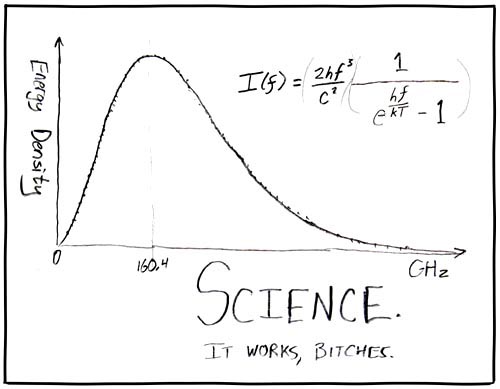
That opaque cloud of ionized matter is called the Last Scattering Surface. The time when atoms formed is called the recombination epoch, so named because of "recombination" of the protons and electrons into hydrogen, though they were in fact combining for the first time ever. The "light" that is radiating through the universe from this event is now known as the Cosmic Microwave Background. We can measure this, and we have.

That plasma cloud is called the Last Scattering Surface because it is the last thing that ever touched (scattered) one of these photons before they reach us. Photons bounced off the Last Scattering Surface, a cloud of hot plasma, 13.72 billion years ago, traveled across the universe for essentially as long as it's been around, and have arrived here on Earth. They are coming equally from all directions, these ancient travelers, and we are bathed in them constantly. Most of the radiation is up at 160Ghz, but some of it also exists down at radio frequencies, and this Cosmic Microwave Background makes up about 1% of the white radio noise we have here on Earth.
This means that when you see snow on an old television, or hear static on an FM radio, a little whisper in that is the recombination epoch. The universe is reaching out to us from a time so ancient that stars had not yet been born. Those empty TV channels and radio stations that we thought of as nothing, they were actually playing the beginning of everything.
After the Big Bang, the universe was extremely hot - hundreds of millions of degrees. So hot that atoms as we know them could not form. It was also expanding very rapidly, and cooled as it did so. Until about 400,000 years after the start, the high temperatures prevented electrons from settling into orbit around a proton to from a hydrogen atom; they would just get ripped away. We say that matter was ionized, that it was plasma. That hot plasma was opaque to light in the same way the clouds or fog are. We say that it scattered light. This lasted until things cooled down to a balmy 3000K. (0K is absolute-zero. 273K is where water freezes.)
At 3000K, electrons could join protons and form atoms as we know them - no longer ionized, no longer plasma. Once the electrons joined up with protons to make hydrogen that wasn't ionized, these atoms let light pass through pretty easily; the fog had cleared. At the moment when those atoms began to form, which was fairly sudden, light could freely make it's way across the universe, and did. Light began traveling from everywhere to everywhere. (I call it light, but it would not have been in the visible spectrum.)
A satellite called COBE (Cosmic Background Explorer) took the measurements, and they correspond so exactly with the values that the Big Bang Theory predicts, that when overlayed they make a single curve. The difference between them is less than a pixel in that image. This is why XKCD put out a fist-pump for science, but it isn't the part that gives me chills.
That plasma cloud is called the Last Scattering Surface because it is the last thing that ever touched (scattered) one of these photons before they reach us. Photons bounced off the Last Scattering Surface, a cloud of hot plasma, 13.72 billion years ago, traveled across the universe for essentially as long as it's been around, and have arrived here on Earth. They are coming equally from all directions, these ancient travelers, and we are bathed in them constantly. Most of the radiation is up at 160Ghz, but some of it also exists down at radio frequencies, and this Cosmic Microwave Background makes up about 1% of the white radio noise we have here on Earth.
This means that when you see snow on an old television, or hear static on an FM radio, a little whisper in that is the recombination epoch. The universe is reaching out to us from a time so ancient that stars had not yet been born. Those empty TV channels and radio stations that we thought of as nothing, they were actually playing the beginning of everything.
Shhhhh, I'm listening to the Big Bang.
Saturday, April 14, 2012
TN Part I: Elephants are not trees.
The state of Tennessee recently passed a "monkey law", celebrated by Discovery Institute as a way to advance their goal of allowing teachers to "present both sides of the evolution debate."
This is Part I of a series addressing this issue.
One of the arguments that I've heard in support of the "monkey law" is essentially that the people of Tennessee have a right to their opinion, and perhaps the rest of us should not be so sure of our own that we would force it down their throats.
One of the arguments that I've heard in support of the "monkey law" is essentially that the people of Tennessee have a right to their opinion, and perhaps the rest of us should not be so sure of our own that we would force it down their throats.
"All opinions are not equal. Some are a very great deal more robust, sophisticated, and well-supported in logic and argument than others." - Douglas Adams
The parable of the Blind Men and the Elephant tells us a story of blind men who, each having the opportunity to feel part of an elephant, come to different conclusions about what it is. There are multiple versions, but in this one the elephant is thought to be a wall, a spear, a snake, a tree, and a fan. The tale seems to be cited most often in theological discussions, and is a caution against arrogance when asserting to know anything with certainty. It is sometimes used to claim that no opinion is better than any other, that it is pure hubris to tell anyone that they are wrong about anything.
There are good lessons in this parable:
1) Our personal experiences and personal knowledge are not comprehensive.
The parable of the Blind Men and the Elephant tells us a story of blind men who, each having the opportunity to feel part of an elephant, come to different conclusions about what it is. There are multiple versions, but in this one the elephant is thought to be a wall, a spear, a snake, a tree, and a fan. The tale seems to be cited most often in theological discussions, and is a caution against arrogance when asserting to know anything with certainty. It is sometimes used to claim that no opinion is better than any other, that it is pure hubris to tell anyone that they are wrong about anything.
There are good lessons in this parable:
1) Our personal experiences and personal knowledge are not comprehensive.
2) We should not dismiss the input of others without consideration.
3) Even our well reasoned conclusions may be inaccurate, because we may lack information.
4) Humility is valuable in our approach to knowledge.
However, the conclusion that no opinion can claim to be better than any other is total nonsense. Not all methods of reaching a conclusion are equally valid, and therefore not all conclusions are equally valid.
In the parable, each blind man touches a portion of the elephant and declares his conclusion based on that alone. The man who touched a leg believed that this object was a tree. I will delete the King from the parable, since his absolute knowledge does not correlate to anything in the real world. The blind men get together to compare notes, and the guy who thinks it is a tree hears that this object has also the features of a spear, a wall, a snake, and a fan.
If he is no fool, then he has begun to suspect that this object may not be a tree after all. However, it is possible that these other men have confused the features. A sharp branch may seem a spear, a flat spot on the trunk may seem a wall, a hanging vine may seem a snake (or there may be an actual snake in the tree), and certainly there are trees with leaves like a fan. What his tree hypothesis requires is more evidence - he must go and see whether these features exist in a configuration that is consistent with a tree, or if they do not.
If he is no fool, then he has begun to suspect that this object may not be a tree after all. However, it is possible that these other men have confused the features. A sharp branch may seem a spear, a flat spot on the trunk may seem a wall, a hanging vine may seem a snake (or there may be an actual snake in the tree), and certainly there are trees with leaves like a fan. What his tree hypothesis requires is more evidence - he must go and see whether these features exist in a configuration that is consistent with a tree, or if they do not.
If he does this, collects his evidence carefully, and considers what can or cannot explain it, he will certainly come to the conclusion that this is no tree. He may realize that it is an elephant, if he is already aware of them. Otherwise, he may be mistaken in his conclusions - he might think that the elephant is an extremely large and strange aardvark, with tusks for stirring ant piles. His aardvark theory would be wrong, but he would still be closer to "truth" than a man who insists that this is a tree. Eventually, with enough evidence collected, he will realize that this creature does not eat ants, and that other findings are not consistent with aardvarks. The quest for knowledge will go on, and whether he ever calls it "elephant" or not, this man will slowly learn more and more about the true nature of his subject.
This is the true moral of the parable: that those who seek and consider all evidence will learn more of truth than those who ignore tusks and trunks and tails so that they can continue to insist that the elephant is a tree.
Creationists are ignoring a great many tusks, trunks, and tails. When a conclusion is drawn despite all evidence, rather than because of it, then we can disregard that conclusion as invalid. Elephants are not trees, and not all opinions about this are equal.
This is the true moral of the parable: that those who seek and consider all evidence will learn more of truth than those who ignore tusks and trunks and tails so that they can continue to insist that the elephant is a tree.
Creationists are ignoring a great many tusks, trunks, and tails. When a conclusion is drawn despite all evidence, rather than because of it, then we can disregard that conclusion as invalid. Elephants are not trees, and not all opinions about this are equal.
Subscribe to:
Posts (Atom)